English
 Indonesia


Sep 08 2026
How to Compare Hydraulic Seal Kit Suppliers Without Relying on Price Alone
Read More >
For a hydraulic parts distributor, an excavator seal kit SKU is more than a label on a shelf. It is a record that connects a machine reference, a specific component, a part number, a kit configuration, packaging information, and the evidence used to confirm compatibility.
When those fields are mixed together, a catalog can become difficult to search and risky to maintain. Two kits may appear similar because they mention the same excavator family, while actually serving different cylinders or components. A customer may provide a familiar machine model, but the order still needs a component reference, part number, drawing, photograph, or dimensions before a supplier can confirm the correct kit.
This guide presents a practical SKU data structure for distributors, repair shops, and fleet-parts teams. It is a management framework, not a statement that every field is already available in JR Seal’s ERP, warehouse, or public catalog.
A distributor usually works with several identification layers at once:
The machine brand and model;
The machine family or series;
The hydraulic component, such as a cylinder, pump, valve, motor, or track adjuster;
An OEM or reference part number;
The seal kit type or repair scope;
The kit’s internal item list and quantity;
Packaging and labeling information;
The evidence supporting the current compatibility status.
These layers should not be collapsed into one long product name. A machine model does not, by itself, identify every seal kit used on that machine. The boom cylinder, arm cylinder, bucket cylinder, pump, and control valve may require different records. A distributor’s catalog becomes more reliable when each SKU represents one clearly defined purchasing unit and its supporting evidence is kept with the record.
The primary SKU should be a stable internal identifier. It should not depend on a temporary supplier description or an image filename.
A useful internal record can include:
| Field | What to record | Why it matters |
|---|---|---|
| Internal SKU | Your own unique inventory code | Prevents duplicate stock records |
| Machine brand | Brand stated in verified product or customer data | Supports catalog filtering |
| Machine model | Complete model and series reference | Separates similar machine families |
| Component | Cylinder or other hydraulic component | Prevents model-only matching |
| OEM/reference number | Number from a reliable source | Supports quotation and cross-reference review |
| Seal kit type | Product or repair-kit category | Clarifies what the record represents |
| Kit quantity | Quantity per kit only when documented | Supports packing and order review |
| Packaging label | Label or carton identification used by the distributor | Helps warehouse and dispatch checks |
| Evidence reference | Photo, drawing, catalog page, or supplier confirmation | Shows why the record is considered usable |
| Compatibility status | Verified, pending review, or not confirmed | Prevents unreviewed records being treated as approved |
| Last verification date | Date of the latest review | Makes stale records visible |
This structure is intentionally conservative. If a field has not been verified, leave it pending rather than filling it with a guess.
The three most important identification fields should remain separate.
The model describes the equipment reference supplied by the customer or shown in approved product information. It can help narrow the search, but it may not identify the exact hydraulic assembly.
The component identifies where the seal kit is used. For an excavator, this may be a hydraulic cylinder or another hydraulic assembly. The component field should be specific enough to distinguish different repair requests.
If a customer writes only “seal kit for [machine model],” the distributor should request the component before treating the inquiry as a complete match.
A part number can be valuable evidence, but it still needs source and context. Record where it came from: a label, an old package, a parts document, a drawing, a customer photograph, or a supplier cross-reference.
Do not replace a verified part number with an internal nickname. Keep both fields if needed:
customer_reference_number;
supplier_reference_number;
internal_sku.
This preserves the original purchasing language while keeping the distributor’s catalog organized.
A SKU record should show the level of verification available at the time. A simple status model can be:
Pending review — the record exists, but model, component, part number, dimensions, or evidence is incomplete.
Information received — supporting material has been collected, but technical confirmation is still required.
Supplier reviewed — the supplier has reviewed the available references and identified the proposed kit.
Sample or drawing pending — further confirmation is required before a batch order.
Approved for the stated application — the available evidence supports the specific model/component/reference combination.
Needs recheck — a change in supplier data, design, material, packaging, or customer application requires a new review.
These statuses are internal controls. They should not be displayed as a universal guarantee unless the supporting evidence and the scope of the statement are clear.
A distributor should know what a kit record represents. Avoid using one SKU for several different configurations unless the record explicitly identifies the variation.
Useful configuration fields may include:
Seal kit category;
Component or application;
Included item references;
Quantity per kit;
Material information when confirmed;
Packaging format;
Label language or customer label requirement;
Sample status;
Revision or last-change reference.
The presence of a field in a database does not prove that the supplier has already confirmed the value. The value should come from a document, approved sample, supplier response, or other traceable source.
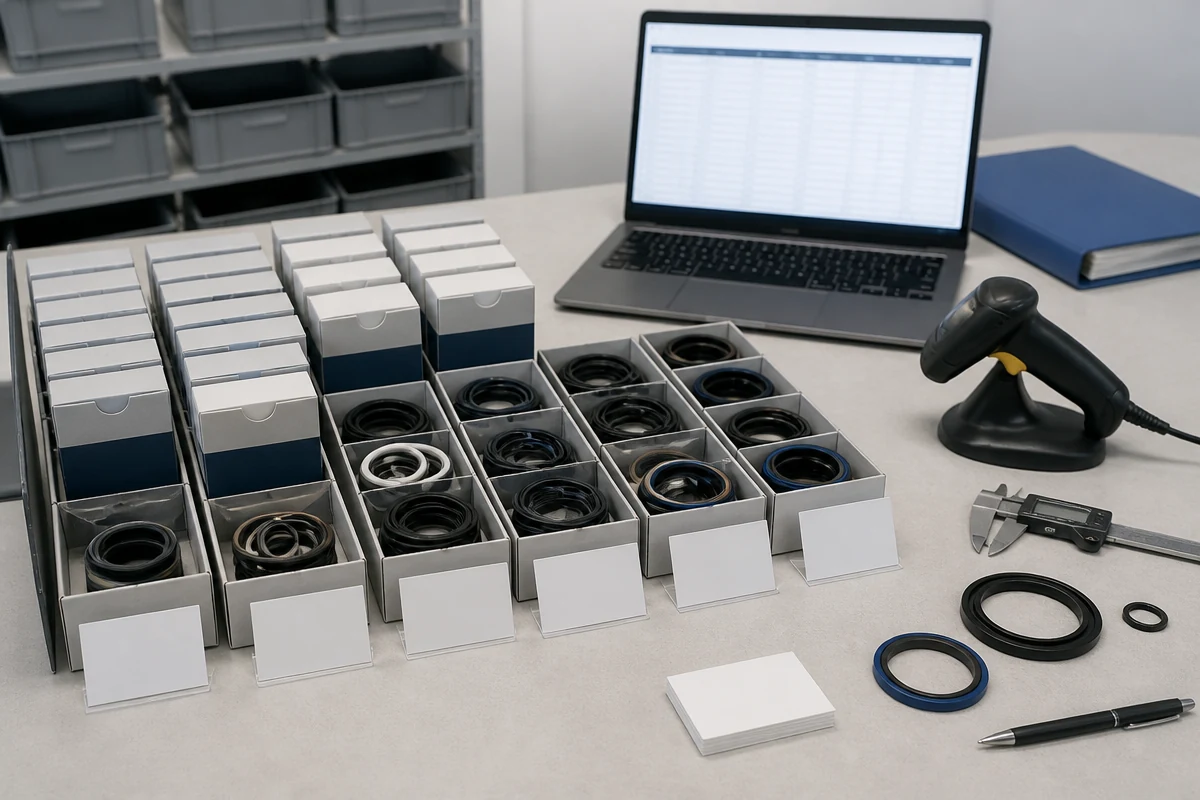
Photos are useful when they are linked to a specific record and captured with enough context. A distributor’s file reference can include:
The customer or inquiry reference;
The machine model;
The component;
The part-number label, if visible;
The date received;
The person or source that supplied the image;
The related quotation or order reference.
A photo should not be treated as complete evidence when the part number is unreadable, the component is unknown, or the image does not show the relevant dimensions. In those cases, the record should remain pending and the missing information should be requested.
A repeatable workflow helps prevent catalog errors:
Capture the customer’s original wording, machine model, component, requested quantity, and available references without rewriting the meaning.
Search by machine model, component, reference number, and product category. Do not approve a match based on one keyword alone.
Review photographs, dimensions, drawings, previous approved records, packaging information, and supplier responses. Record missing evidence instead of filling the gap with an assumption.
Use a controlled status such as pending, supplier reviewed, sample pending, or approved for the stated application. Include the date and reviewer where your process supports it.
The description should identify the equipment reference, component, and scope of the kit. It should not promise compatibility outside the evidence reviewed.
Keep the original inquiry, the final reference used, the supplier response, and any change history connected to the SKU. This is especially important when a distributor updates an existing record rather than creating a new one.
Before creating a new record, search the catalog using several combinations:
Machine brand + model;
Model + component;
Part number;
Supplier reference;
Internal SKU;
Photo or drawing filename;
Previous quotation or order reference.
If two records appear similar, compare the component and evidence before merging them. Do not merge records only because the product titles contain the same machine model. If a change affects the kit contents, component, material, packaging, or approved application, it may require a new revision or a separate SKU according to the distributor’s own system.
JR Seal publicly presents hydraulic cylinder seal kit categories and model-specific product pages. These pages can be used as starting points when a distributor is checking a product category or preparing an inquiry. They should not replace the final model/component/reference review for a specific order.
Use the Hydraulic Cylinder Seal Kit category to review the public category structure. When the inquiry needs a specific product or a custom review, use the Customization page and provide the available model, component, part number, photos, dimensions, and quantity. For a quotation or clarification, use Contact Us.
Before marking an excavator seal kit SKU as ready for customer-facing use, ask:
Is the internal SKU unique?
Is the machine model recorded exactly as received or verified?
Is the component identified separately from the machine model?
Is the OEM or reference number traceable to a source?
Is the kit category clear?
Are kit contents and quantity documented, or marked pending?
Is packaging information confirmed, or still under review?
Are the relevant photographs or drawings linked to the record?
Is compatibility status explicit?
Is the last verification date recorded?
Does the customer-facing description avoid unsupported guarantees?
Can the distributor explain what information is still needed for a final match?
A useful excavator seal kit SKU is an evidence record, not just a short product name. Separating machine model, component, part number, kit configuration, packaging, and compatibility status gives distributors a clearer way to search, review, and update their catalog.
When an inquiry is incomplete, the safest next action is to request the missing model, component, reference number, photograph, dimensions, and quantity. For a product or custom matching request, contact JR Seal with the available information so the specific application can be reviewed before ordering.