English
 Indonesia
Sep 22 2026
How to Request a Custom Hydraulic Seal Kit from a Sample or Drawing
Read More >
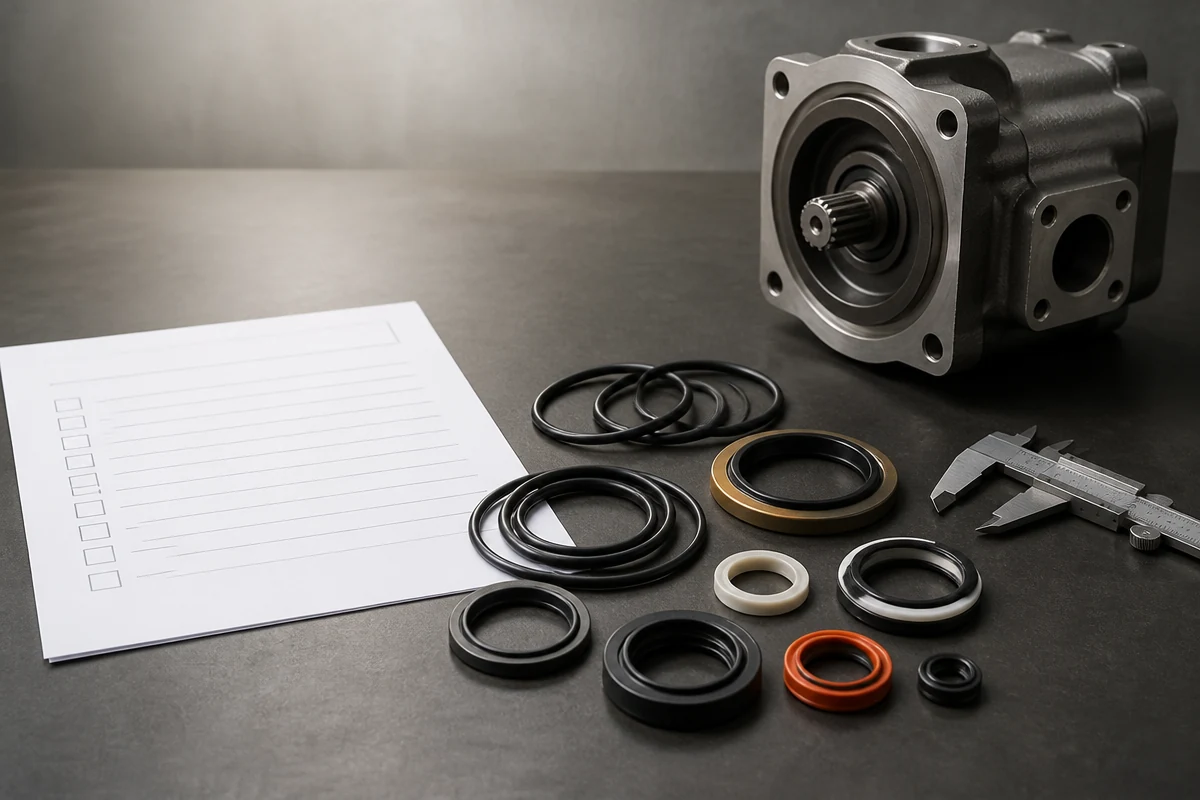
A useful hydraulic pump seal kit RFQ starts with identification evidence, not with a product name alone. Repair and maintenance teams usually need to match a seal kit to a pump assembly, a machine, or a failed set of seals. If the first request does not distinguish those details, the supplier may need several rounds of clarification before a quotation can be prepared.
This checklist helps maintenance planners, parts buyers and repair workshops assemble the information for a hydraulic pump seal kit quotation. It does not replace the pump maker's service documentation. Instead, it gives you a practical way to organise the references, photos, measurements and quantity details you can actually verify before you send an RFQ.
Record the information that identifies the equipment before listing the seals. Include the machine type, machine model, pump assembly name and any reference that appears on the pump plate, service document or parts record. If the pump is installed on an excavator or another construction machine, record the machine model separately from the pump reference.
Machine make and model, if available.
Pump make, model or assembly reference, if marked.
Machine serial or production information, only when it is available and relevant to your records.
Whether the request is for a complete repair kit or selected replacement seals.
Keep the original spelling and punctuation of every reference. A partial or uncertain code should be marked as uncertain rather than silently corrected. This gives the supplier a clear starting point for a compatibility review.
A pump reference identifies the assembly, while the seal kit request identifies the sealing parts needed for a repair. State which pump section is being serviced and whether the request covers one assembly or several. Do not assume that a general pump name is enough to identify the exact repair set.
Write the assembly name exactly as it appears in your maintenance record.
List the seal position or component name when your service information provides it.
State whether the removed parts are being replaced as a full set or individually.
Attach a marked diagram only when you can identify the relevant area with confidence.
If the assembly reference and the seal-kit reference do not match, include both. The difference may simply reflect an internal parts convention, but it should be visible in the RFQ rather than left for the supplier to guess.
If you have a previous invoice, package label, parts list or service record, copy the pump seal kit part number exactly and identify where it came from. A supplier can then compare the historical reference with the current pump information and the physical evidence.
Previous seal kit part number, including dashes or suffixes.
Source of the number: package, invoice, manual, parts list or internal stock record.
Date or repair event associated with the reference, if known.
Any alternate reference already used by your team, clearly labelled as an alternate.
Do not present a number found on a similar-looking listing as a confirmed match. Similar pump or machine descriptions are not sufficient evidence on their own.
Photos help a supplier understand what the written reference cannot show. Take the photos before cleaning or discarding the removed parts, and keep the relationship between each seal and its original position as clear as possible.
Photograph the pump nameplate or reference area when it is safe and permitted.
Photograph the removed seals together with a simple position note.
Include an overall view and close views of tears, flattening, hardening or other visible damage.
Use a scale reference only when it does not hide the seal profile or markings.
Use neutral file names and identify each image in the RFQ message. Avoid relying on a single close-up that hides the assembly context.
When no reliable part number is available, measured evidence becomes more important. Record what was measured, where it was measured and which units were used. If a seal is worn or distorted, note that the dimensions may not represent its original size.
Inside and outside dimensions of the seal, where measurable.
Cross-section or thickness at more than one point.
Groove dimensions when the seal is being replaced in an existing groove.
Relevant shaft, bore or housing dimensions at the sealing position.
Visible scoring, steps or wear on the mating surface.
A quick sketch can prevent a dimension from being assigned to the wrong edge. Mark nominal values from a drawing separately from values measured on the removed part or pump hardware.
Include the operating information that your maintenance or service documentation can support. The purpose is not to fill every field with an estimate; it is to show the conditions the proposed seal kit needs to be reviewed against.
Fluid type or hydraulic oil specification, if recorded.
Observed or documented temperature range.
Working pressure and any documented pressure peaks.
Rotation, reciprocation or static sealing motion at the relevant position.
Contamination, unusual wear or failure conditions observed during inspection.
When a value is unknown, write “not available” and provide the source of the other values. A transparent gap is more useful than an unsupported number.
State the purchasing requirement in a way that can be checked against the quotation. Tell the supplier how many pump assemblies the request covers and whether the parts are for an immediate repair, a planned maintenance batch or stock replenishment.
Number of complete kits required.
Number of machines or pump assemblies covered.
Complete kit or selected seal components.
Individual labelling or packing references needed by your workshop.
Whether the same reference may be reordered later.
Keep quantity and kit scope separate. “One kit” can mean different things unless the components and the supported assembly are identified.
Ask the supplier to return the quotation against the evidence you supplied. A useful response should make it possible to compare the proposed kit with your pump reference, requested quantity and RFQ attachments.
Quoted reference or internal item code.
Component description and kit scope.
Quantity and packing description.
Any clarification needed about the pump, seal position or measurements.
Confirmation of which information was used to prepare the quotation.
If the quotation uses a different reference from your record, ask for the relationship to be explained before approval. Keep the final approved reference with your maintenance record for future requests.
JR Seal publishes a Hydraulic Pump Seal Kit product page with pump-kit product navigation, including model-specific pages visible from the category. Use the category page to orient the request, then send your own pump reference and evidence rather than assuming a listed model is a confirmed match.
For requests that need review against drawings, samples or a specific sealing requirement, see the Customization page. For the complete evidence pack and quotation request, use Contact Us.
Before you send the request, check that the machine and pump references are separated, the part number source is identified, the seal photos and measurements are attached, service conditions are supported by your records, and quantity and kit scope are explicit. Then send the evidence pack through the JR Seal contact page for review.