English
 Indonesia

Oct 10 2026
JR Seal Leadership Joins Guangzhou Construction Machinery Industry Association on Strategic Visit to Authorized Caterpillar Dealer Sime CEL
Read More >

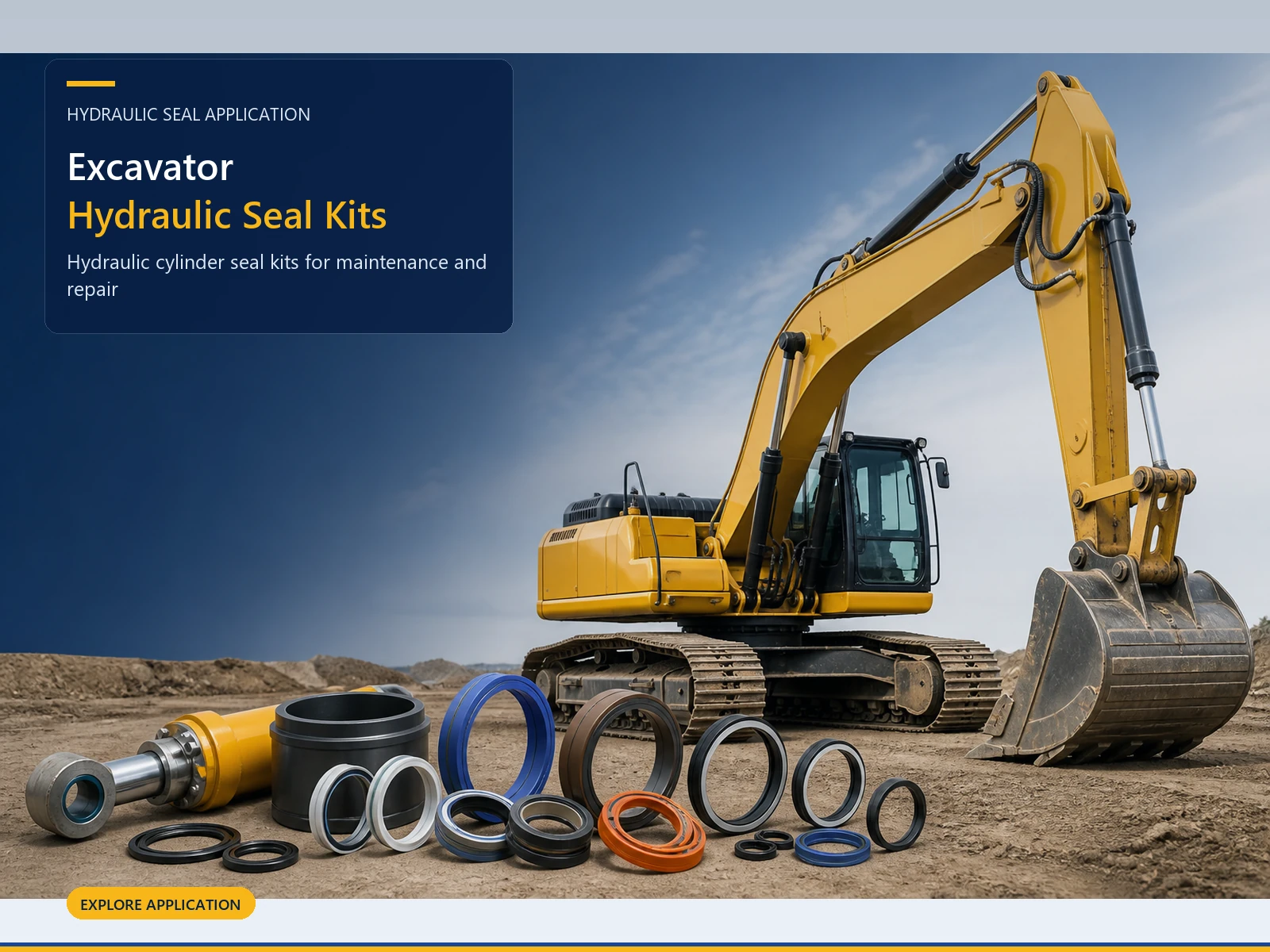
An excavator is a high-pressure, multi-actuator machine. Several cylinders, a main pump, a control valve block and two independent motor groups all contain dynamic and static seals that wear at different rates. When one of them starts to leak or lose position, the symptom usually appears long before the machine stops working: a cylinder that creeps down overnight, oil film on a rod, a slow swing, or a track that needs frequent adjustment.
This page describes excavator hydraulic sealing applications by component. It is general application information for maintenance planning and spare parts sourcing. Hydraulic sealing applications for selected excavator models from Caterpillar, Komatsu, Hitachi, Kobelco, Volvo, Sumitomo, Kato, Doosan, Hyundai, JCB, Case, Sany, XCMG and other major brands. Confirm the model, component and part details before ordering.
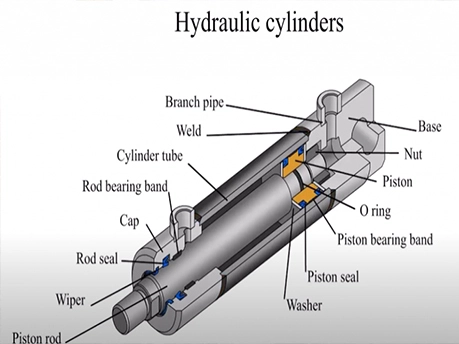
Cylinders are the most frequently re-sealed group on an excavator. Boom, arm and bucket cylinders work continuously, and each one normally carries a rod seal, a wiper or dust seal, a buffer seal, a piston seal, wear rings and a set of static O-rings and backup rings. Bucket cylinders often wear fastest because they sit closest to the working tool and receive the most impact.
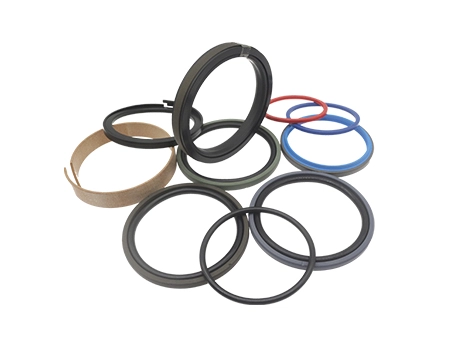
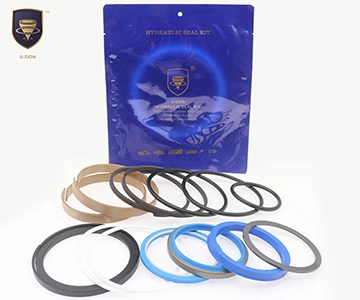
Typical symptoms of cylinder seal wear include an oil film on the rod, oil collecting around the wiper, drift under load, and in severe cases a loss of holding pressure. See the excavator hydraulic cylinder seal kit and the general hydraulic cylinder seal kit for the seal groups involved.
Pump sealing is usually about the shaft seal, the O-rings between housings and end covers, and the seals in the control section of the pump. A failing shaft seal shows up as oil inside the coupling housing or oil being pushed out of the drain line. Pump re-sealing is more sensitive than cylinder work because clearances and internal surface condition have a large effect on the result, so the pump should be inspected before a seal kit is fitted.
See the hydraulic pump seal kit for the general seal composition.
The main control valve contains many small O-rings, backup rings and spool seals. Leakage here often appears as external weeping between sections, drifting functions, or a function that loses speed when another function is operated. Because control valves are assembled in stacks, it is good practice to re-seal the whole section rather than only the visibly leaking joint, and to keep the parts of each section separated during disassembly.
See the control valve seal kit for the general seal composition.
The swing motor and its reduction gearbox form a combined unit on most excavators. Sealing work typically includes the shaft seal between the motor and the gearbox, the O-rings in the motor body, and the seals at the brake and valve sections. Oil migration between the hydraulic side and the gear oil side is a common sign that the separating seal has failed, and a swing that drifts or brakes slowly should be checked before the fault develops further.
See the swing motor seal kit for the general seal composition.
Travel motors operate in the dirtiest position on the machine, close to the undercarriage and often partly submerged. The shaft seal, the O-rings in the motor body and the seals in the travel brake and valve sections are the usual items in a travel motor seal kit. External leakage and oil appearing around the final drive, or a track motor that loses power when hot, are typical reasons for inspection.
See the travel motor seal kit for the general seal composition.
The track adjuster is a small cylinder with a check valve that keeps track tension. Its seal set is inexpensive relative to the cost of a seized adjuster, so re-sealing during undercarriage service is a practical preventive step. Common signs of wear are a track that gradually loses tension, grease escaping from the adjuster, or tension that cannot be restored by greasing.
See the track adjuster seal kit for the general seal composition.
The center joint, also called the rotary joint or swivel, transfers hydraulic oil from the upper structure to the travel circuit while the machine rotates. It contains a stack of seals between the rotating and stationary parts, and leakage shows up as oil appearing around the centre of the undercarriage or as travel functions weakening. Correct seal order and orientation matter more here than in most other components.
See the center joint seal kit for the general seal composition.
Most excavator sealing problems fall into a small number of categories: normal wear from contamination and heat, installation damage such as a rolled, cut or twisted seal, surface damage on the rod or bore, incorrect seal selection for the pressure and temperature of the circuit, and oil degradation that hardens or swells the seal material. Of these, contamination and installation damage are the two that most often cause a repeat failure shortly after a repair.
Practical countermeasures include careful cleaning before assembly, protecting the seal from sharp edges during installation, checking the rod and bore for scoring, and confirming that the replacement seal is the correct profile and material rather than only the correct dimension.
Matching is normally done from the component rather than from the machine. To allow a proper check, provide the excavator model and series, the hydraulic component involved, the seal dimensions or the original part number, and photographs or a cross-section drawing of the removed seal if these are available. Where a seal kit number is known, it is the fastest route to a match, because the same machine model can be built with more than one hydraulic component generation.
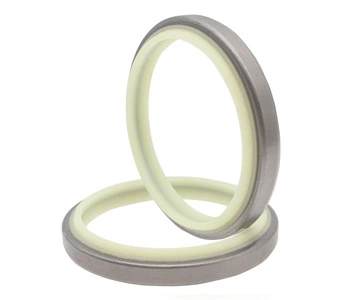
Dust seals, buffer seals and other individual sealing elements can also be supplied when only one part of the assembly has failed. See the dust seal and buffer seal pages for these components.
Not necessarily. Re-seal the cylinder that has failed and inspect the others, but keep in mind that cylinders working in the same circuit under the same conditions often reach the end of their seal life at similar times.
Yes. Individual seals, wipers, buffer seals and O-rings can normally be supplied in the required quantities.
No. Rod damage, bore damage, excessive side load and contaminated oil can all cause leakage even with a new seal.
Send the excavator model, the hydraulic component and either the seal dimensions or the original part number. JR Seal will review the application and reply with a suitable option or a request for further details. Please contact JR Seal to start a matching enquiry.