English
 Indonesia



Oct 13 2026
Travel Motor vs Swing Motor Seal Kit Requests: What Buyers Should Separate
Read More >
Submitting an inquiry for replacement hydraulic seals without complete technical parameters is one of the primary reasons for delayed quotations, back-and-forth email exchanges, and costly installation errors. In heavy machinery maintenance and aftermarket parts distribution, ordering the wrong seal kit not only stalls machine operation but also leads to premature hydraulic failure under high working pressure.
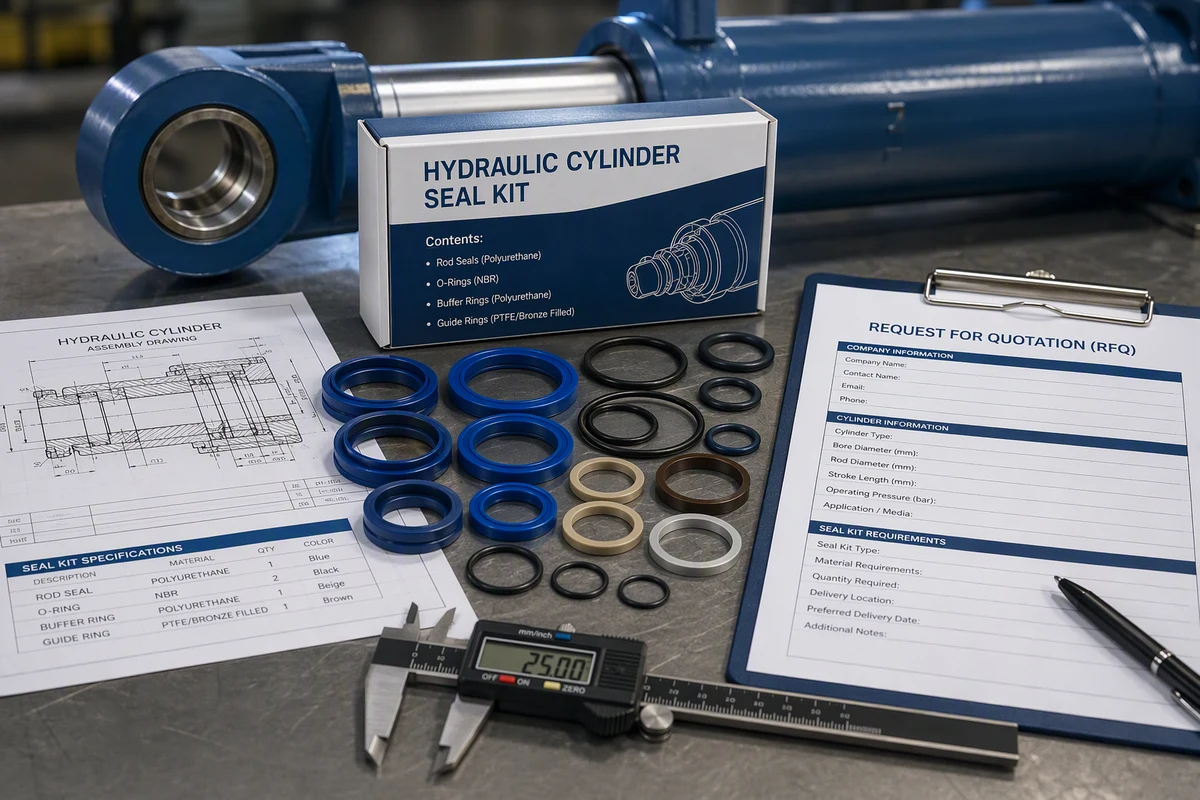
A professional hydraulic seal kit RFQ (Request for Quotation) provides an equipment supplier or manufacturer with the precise data needed to identify exact replacement components on the first review. Whether you are ordering a single hydraulic cylinder seal kit for an emergency field repair or procuring wholesale stock for distributor inventory, structuring your inquiry with verified data ensures immediate pricing and accurate kit assembly.
In heavy construction and industrial machinery, hydraulic cylinders, pumps, and control valves undergo continuous engineering revisions throughout their production lifecycle. Two excavators sharing the same model badge may use completely different rod diameters or gland depths if their serial numbers belong to different manufacturing years or regional variants.
When an excavator seal kit supplier receives an ambiguous request such as "Send quote for 20-ton excavator boom seals", technical engineers cannot confirm whether the cylinder uses a standard stepped buffer ring, a tandem rod seal configuration, or a metric versus imperial piston seal groove. A structured RFQ form eliminates guesswork, enabling suppliers to match OEM bills of materials (BOM) or recommend exact dimensional equivalents without unnecessary delays.
The foundation of any replacement seal inquiry is accurate machine and component identification. Before measuring individual rubber or polyurethane components, record the following equipment plate details:
Equipment Brand and Exact Model: Record the complete model designation, including sub-series suffixes (e.g., Cat 320D vs. 320D2, Komatsu PC200-7 vs. PC200-8, Hitachi ZX240-3 vs. ZX240-3G).
Machine Serial Number (PIN): Found stamped on the machine frame identification plate. Serial numbers allow suppliers to trace factory cylinder revisions in OEM parts catalogs.
Hydraulic Component Position: Clearly state the cylinder function—Boom Cylinder, Arm/Stick Cylinder, Bucket Cylinder, Blade Cylinder, Steering Cylinder, or Outrigger Cylinder.
Cylinder Assembly Stamping: Check the cylinder barrel or head gland for stamped assembly part numbers, which distinguish OEM factory cylinders from aftermarket replacements.
Providing verified part numbers is the fastest route to receiving a firm hydraulic cylinder seal kit quotation. A comprehensive RFQ should list all available part identifiers:
OEM Master Kit Part Number: The primary number assigned by the equipment manufacturer (e.g., Caterpillar, Komatsu, Volvo, Kobelco, Doosan, Sany).
Individual Seal Part Numbers: Part numbers stamped on specific components, such as rod seals, piston seals, wear rings, or dust wipers.
Seal Manufacturer Profiles: Common profile designations (e.g., SPGO, SPGW, ODI, IDI, ISI, DKBI, HBY) often molded directly into polyurethane or rubber seal bodies.
Previous Supplier Reference: Aftermarket SKU numbers from prior maintenance records or packaging labels.
When repairing legacy machines, obsolete equipment, or custom cylinders without accessible part numbers, precision seal kit dimensions are mandatory. To prevent distortion errors, always measure metal groove dimensions rather than deformed, worn-out used seals whenever possible:
Rod Diameter (d): The precision ground diameter of the chrome cylinder rod.
Bore Diameter (D): The inside diameter of the cylinder tube/barrel.
Groove Width / Axial Length (L / H): The axial width of the seal gland machined into the cylinder head or piston.
Groove Depth / Radial Cross-Section (S): The radial depth from the gland bottom to the mating dynamic surface.
Wiper Housing Step Dimensions: Bore diameter, shoulder depth, and press-fit housing diameter for metallic or snap-in dust wipers.
Standard hydraulic seals are typically formulated with Nitrile Rubber (NBR 70–90 Shore A), Polyurethane (PU / TPU), and PTFE with bronze or carbon fillers. However, demanding working conditions require specialized elastomer selection. Include the following application parameters in your RFQ:
Maximum System Pressure: Indicate typical continuous working pressure and peak surge pressure (e.g., 25–35 MPa for excavators, 40+ MPa for hydraulic breakers).
Operating Temperature Range: Standard mineral oil applications operate between -20°C and +100°C. High-ambient desert mining or cold-climate forestry require FKM (Viton) or low-temperature PU compounds.
Hydraulic Fluid Type: Standard mineral hydraulic oil, biodegradable synthetic esters (HEES), water-glycol fluids, or phosphate esters require specific chemical compatibility verification.
Environmental Exposure: Abrasive dust, rock slurry, saltwater exposure, or high-frequency impact cycles influence wiper lip geometry and guide ring material selection.
To streamline communication with your supplier, use the following standardized RFQ table layout when submitting multi-line inquiries:
| RFQ Field | Required Information | Example / Notes |
|---|---|---|
| Equipment Info | Make, Model, Serial Number | Komatsu PC200-8, PIN: 30001-UP |
| Component Type | Cylinder / Pump / Valve / Motor | Boom Cylinder (Left / Right) |
| Part Reference | OEM Kit No. / Stamped Codes | 707-99-44110 / DKBI 90x105 |
| Key Dimensions | Rod OD × Bore ID × Gland Width | Rod: 90mm, Bore: 130mm |
| Order Quantity | Kits per item / Packaging request | 20 sets (Neutral polybag + label) |
| Working Medium | Fluid type, Operating Temp | ISO VG 46 Mineral Oil, -20°C to +80°C |
When exact drawings are unavailable, high-resolution photographs provide critical engineering confirmation. For maximum clarity, attach the following images to your inquiry:
A clear photograph of the complete machine nameplate and cylinder serial stamping.
An overview shot of the disassembled cylinder head, piston, and rod assembly.
Individual seals arranged on a flat surface, with profile cross-sections and internal lip orientations clearly visible.
Digital vernier caliper readings showing measured inner diameter, outer diameter, and cross-sectional thickness.
At JR Seal (Guangzhou Jiarui Seals Co., Ltd.), we specialize in manufacturing and supplying precision-engineered hydraulic seal kits for excavators, wheel loaders, hydraulic breakers, pumps, and mobile industrial machinery.
Whether you require standard OEM replacement seal kits or bespoke configurations through our Custom Hydraulic Seal Kit service, our engineering team is ready to cross-reference your part numbers, verify dimensions, and deliver competitive wholesale quotations within 24 hours.
Ready to submit your inquiry? Send your parts list, drawings, or model numbers directly to our technical sales team via our Contact Us page or email us at jr@djfseal.com.